
The Two Arrows

Like many others in our field of dementia care, I have found that mindfulness practices like meditation gives me the resilience that is so essential to sustain my work. I was inspired for this month’s blog after a meditation during a podcast I follow: Home | The On Being Project.   Buddha observed and explained many aspects of human nature and suffering 2500 years ago that remain ever relevant today. The Buddhist allegory of The Two Arrows is a lesson related to how we choose to respond to a painful event. The first arrow, or triggering experience, causes the initial pain. The second arrow “is our reaction to the first. This second arrow is optional.” Looking at the Two Arrow analogy in a bio neurological way, our limbic system automatically kicks when triggered by a painful event, like the impact of an arrow, leaving us with only three options: fight, flight, or…
Continue ReadingThe Two Arrows

What the World Needs Now is Love Sweet Love — Dionne Warwick

We revisited the Summer of Love last Friday during Healing Arts with Diane Stenlund. She played a wonderful mix of songs from 1967 and created a scrapbook of album covers with colorful artwork inspired by the times.  Wherever one falls within a cultural phenomenon like the Summer of Love, the impact can be lasting. Reflecting on earlier experiences can reunite us with our unique identities, and offer a different perspective whether we have memory impairment or not.  We sang along to the Beatles and shook our tambourines; making connections to each other and bypassing the differences of several generations.  Memory loss can be devastating at times. We all hope that the last Alzheimer’s patient will come in our lifetime. One of the important steps in tackling this sticky neurological disease is getting standardized testing for primary care physicians. It looks like we have such a test: The p-tau217 blood test combined…

Continue ReadingWhat the World Needs Now is Love Sweet Love — Dionne Warwick

Stroke on the Rise

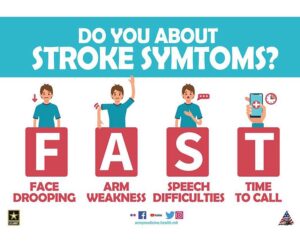
In the early 1990s I worked in skilled nursing facilities doing therapeutic activities with frail elders, and about a third of the population I assisted were recovering from a stroke. Much of my training and experience was focused on how to improve post stroke conditions that included partial paralysis, contractures, speech and communication impairments, delayed auditory processing and muscle weakness.  During that nearly 10 years of working in a nursing home setting, public health and medical communities were making solid strides toward decreasing incidence of stroke through medications for hypertension, statin medications, changes in dietary guidelines and smoking laws. The goal was to decrease levels of disability associated with aging — stroke being one of the biggest culprits.  As I started researching materials this month to prepare for a staff training on how to respond to signs of stroke, I realized that we are headed in the wrong direction. Since…

Continue ReadingStroke on the Rise

Self-Care 

Self-care is essential for caregivers to regain the inner strength and energy it takes to do our jobs well. We hear it all the time. And yet, many of us find ourselves initiating steps for self-care when we are already depleted or completely drained. One of the underlying ideas behind a truly supportive self-care routine is to incorporate it into daily life, and hopefully avoid reaching that maxed out state-of-being.  Each person’s version of self-care is unique because self-care is all about what you want it to be. A supportive self-care routine needs to be based on your own interests and what makes you feel wellbeing at your core once again. And self-care has nothing to do with pleasing others! Self-care time is stress and pressure free. It can be just a few minutes or several hours. Time spent in nature can be incredibly restorative but maybe a spontaneous trip…

Continue ReadingSelf-Care 

Caregiving is an Art that Science Elevates

When we became licensed in 2011 to operate our first dementia care home, I quickly realized that developing solid caregiving skills was the most important thing I could do. My law degree, framed beautifully and hanging on the wall of our living room, didn’t mean anything to the frail elders in my care. Like many caregivers, I unexpectedly gained more than I could have imagined.  And my esteem for caregivers everywhere has only grown.  I have asked myself many times why caregiving is not yet fully appreciated in our society? First, we have been told for generations that for one to be viewed as valuable to society a college degree is required. Yet, the incredibly important skills of a caregiver, like many essential tradesmen and artisans, are not found on any college course syllabus.  Second, our society creates mixed messages about what skills and jobs are important — ie, if…

Continue ReadingCaregiving is an Art that Science Elevates

Sweet Home California

ROSHI’S POEM Whenever I hearThe edgeless soundIn the deep nightO Mother!I find you again. Whenever I standBeneath the lightOf the seamless skyO Father!I bow my head. The sun goes downOur shadows dissolveThe pine trees darkenO Darling!We must go home.— Leonard Cohen This morning I walked around my backyard and heard, first, the sound of a California Oriole calling out to claim he has returned to his California home. Then, looking for him among the plum blossoms, I could see his bright yellow feathers and regal black hood. He and his mate have returned home to nest and raise their next generation. Home is a universal and instinctual desire to have and create. Trying to include some important elements of what each resident feels is home for them is a calling of ours. What are the important elements needed to call a place home? There are many. I thought of a…

Continue ReadingSweet Home California

Young and Old: Together We Rock!

Families are made up of different generations; making life inherently more interesting. Visiting residents in assisted living and dementia care can be multigenerational too. I have witnessed the many kinds of changes that residents experience with dementia and have tremendous sympathy for their families. Diagnosis and treatment for Alzheimer’s or vascular dementia continue to pose a great challenge. And we know that a truly viable treatment is decades away while early prevention is somewhat of a guessing game.  Sounds daunting, yes. Yet, we are left with many choices on how to move forward — first and foremost is to not give up. We can work together to create an environment and routine filled with family, friends, and joyful moments. It’s not possible of course to create a perfect world for loved ones, however there is so much we can do to help during this journey.   I have witnessed families face…

Continue ReadingYoung and Old: Together We Rock!

Opening a Dialogue to Advanced Dementia and the Sacred Act of Dying

A hospice nurse recently reminded me that each person will have a unique way of dying, and that dying is a sacred time for them.  I believe that those tending to the dying person are presented with the honor of applying care practices that support this sacred process.  Since I work with people who have Alzheimer’s, Parkinson’s or vascular dementia, I have already witnessed the brain failing before the body is fully ready.  As I have come to say, this leaves us with heart centered work. So the sacred piece of the puzzle at end of life has become an important part of my learning and sharing.

Continue ReadingOpening a Dialogue to Advanced Dementia and the Sacred Act of Dying

The Milkshake Study

The labels and language we use around dementia affect how we experience caregiving. The words we choose affect how we feel about it and how we understand the problems to begin with, as we try to solve the many puzzles that dementia creates just navigating daily life.  Our expectations around caregiving are shaped by the words and labels we use. These expectations are incredibly powerful and impact how we think and experience our work. An insightful study, famously called the Milkshake Study, from Stanford University demonstrates this truth. The study measured ghrelin levels (the hormone that tells our brain we are full during mealtimes). They conducted lab tests with two groups of participants who drank the exact same milkshake mixture. The only difference was the expectation created by the words used to describe the milkshake. One group was told their milkshake was high calorie and the other was told their…

Continue ReadingThe Milkshake Study

The 6th Sense

The holiday season can create beautiful, tasty and enjoyable moments through our five senses. Drinking a cup of hot apple cider brings the smell of cinnamon, the sweet taste of apple, warmth on our lips, a view of a silly holiday cup, and the clinking sound the cup makes when it is set down on the table. Perhaps a fond memory is triggered by these senses.  We can pick up the cup and drink the delicious cider because we have, what could be called, the 6th sense: proprioception — the sense that lets us perceive the location, movement, and action of parts of the body.  We take for granted our ability to know where our body is in space at all times through the coordination of a complex network between our brain and the receptors involved in the five senses. It’s how an olympic ice skating team can skate on ice…

Continue ReadingThe 6th Sense