
When we became licensed in 2011 to operate our first dementia care home, I quickly realized that developing solid caregiving skills was the most important thing I could do. My law degree, framed beautifully and hanging on the wall of our living room, didn’t mean anything to the frail elders in my care. Like many caregivers, I unexpectedly gained more than I could have imagined. And my esteem for caregivers everywhere has only grown.
I have asked myself many times why caregiving is not yet fully appreciated in our society? First, we have been told for generations that for one to be viewed as valuable to society a college degree is required. Yet, the incredibly important skills of a caregiver, like many essential tradesmen and artisans, are not found on any college course syllabus.
Second, our society creates mixed messages about what skills and jobs are important — ie, if a job is important it must be high paying and the people performing those jobs must also appear to lead glamorous lives. Caregiving is far from glamorous. Florence Nightingale, in the mid 1800s, launched modern nursing during the mucky muck of the Crimean War and remains a shining example of how to be in service to others.
We also view jobs that use the latest technology as being important. Truly good caregiving does not require technology, it requires technique. Here is where the science comes in. Teepa Snow, Occupational Therapist, and hero at large for people living with dementia, puts the science to work for caregivers around the globe. One of the best examples I can give is the way Teepa has connected occipital lobe research with improved caregiving techniques. Place the palm of your hand on the lower back of your head and you have found your miraculous occipital lobes. As neurons progressively die due to the build up of beta-amyloid plaques (the hallmark of AD), the progression leads to changes in the occipital lobes. Research shows that by this time in the progression of the disease, changes have already been occurring in the parietal and temporal lobes. Basically, changing how a person experiences sensory input from their world, how they move their body in space and time, and how they see their world. And yet most still see Alzheimer’s as just a memory problem.
The build-up of beta amyloid plaques in the occipital lobes eventually leads to monocular vision. Changes that occur not due to some kind of mechanical breakdown in the eyes, but due to brain change. Monocular vision means the loss of depth perception and seeing the world in 3 dimensions. So the world that was once gloriously in 3D is now flat, and determining how far away an object is just by looking at it becomes impossible. Now the only way to know is to feel ones way around to determine what is 3D, or how far away something is. Try this — close one eye, make a circle with your fingers and place around the other eye, then pick up a pen and write your name. This gives us a glimpse into how a loved one could be experiencing vision changes. Isn’t it amazing how well loved ones are doing considering these incredible changes they live with every day? And isn’t it clear how important it is that we understand the changes underway in the brain? I can’t imagine how to help someone brush their teeth or wash their face if I didn’t understand how they see their world.
Now that we have a better understanding from the research on occipital lobes, it’s time to connect the dots in our caregiving work of art. And so I turn to a bigger brain than mine, and take the view of an Occupational Therapist like Teepa. Voila! Positive Approach techniques have been created to help caregivers and people living with dementia to ease daily care. Number one: Approach the person in care from 6 feet away so that you are in their field of vision, slightly to the side, with a kind open hand and a verbal greeting to put them at ease; Like, “Good morning. I am Kelly and I am here to help you with your care and to get ready for breakfast. How are you feeling this morning?” Number two: Approach with your right hand out, reaching to the person’s right hand to physically connect before taking steps with personal care. (Or approach with the left if that is the dominant hand.) Why? Because of vision changes, if a caregiver first touches before taking steps for the person in care to see and hear them, they may inadvertently cause a startle effect — Making the next steps for morning care more difficult than necessary. Startling a person means triggering the fight or flight limbic system, releasing adrenaline and cortisol into their blood stream that can remain in their system for hours.
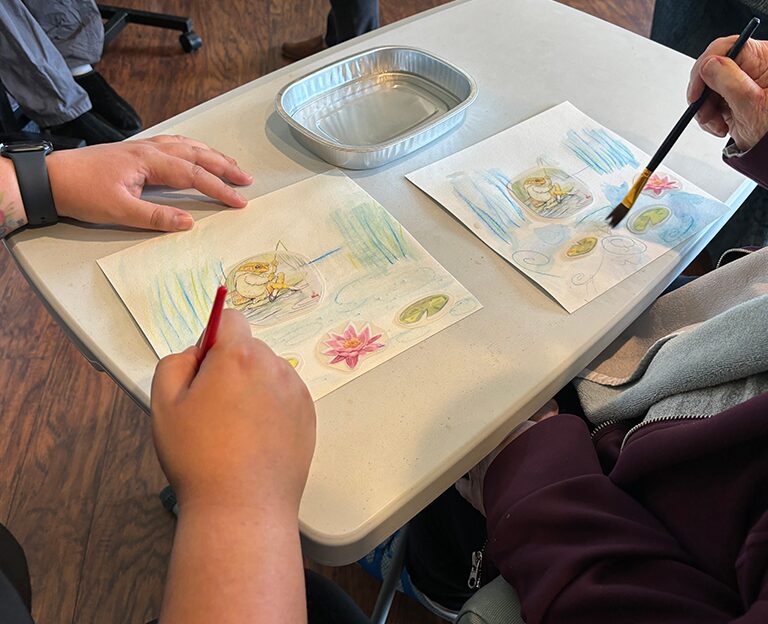
As caregivers we are constantly improving our understanding of the neurological changes underway while applying personal communication skills, emotional intelligence, medication training, infection prevention knowledge, safe body mechanics and active compassion. Caregiving is an art form in many ways that is informed by the research at-hand. More science and more research is needed as we face unprecedented numbers of people needing care.
Resources:
Teepa Snow:
https://teepasnow.com/blog/this-is-your-brain-on-ice-cream-part-2-occipital-lobe
National Library of Medicine:
Thank you Kelly. There is so much to learn and I appreciate your sharing.
Thank you Sally!
Одна из лучших особенностей Google Trends заключается в том, что он постоянно обновляется новыми данными,
а это значит, что вы всегда сможете найти
свежую и актуальную информацию.