
Hospice Care: Food Intake at End of Life
As caregivers, meeting nutritional and hydration needs is second nature to us. We also know that there comes a time to pause and rethink our resident’s (loved one’s) food intake; watching carefully for signs that they are no longer feeling hunger or wanting food. Months before the dying process we often see residents gradually become less interested in food. And eventually, stop eating. This is a normal and natural process that the body is undergoing.
The natural progression of end-of-life can involve gradual or abrupt changes in food and fluid intake. Each person is unique. Barbara Karnes, RN wrote a series of books about the dying process, including her latest book about how to honor a person’s refusal of food: Always Offer, Never Force (End of life education materials for families and professionals – BK Books). In this month’s training, we are focusing on how to support our residents with their journey of ups and downs with food intake.
As residents living with dementia progress towards more assistance with meals, we provide a variety of approaches.
- Adaptations to cups, plates and utensils: We can provide adapted utensils for easier use during meals. These include larger grips that attach to forks and spoons, bendable utensils, or weighted utensils (to ease tremors). Cups with handles, straws or tops that seal with a spout for better fluid intake with less spills. And plates with high sided partitions to make it easier to scoop. Many of these adaptations are designed to help the resident retain independence with their meals.
- Hand-under-hand or hand-over-hand physical assist: For residents needing more physical assistance with meal intake and who are able to partner with us, we can apply either approach depending on which one is most comfortable. Hand-under-hand assistance places the caregiver’s hand on the utensil and the resident’s hand over the caregiver’s hand. This approach works well and allows the resident to feel the motion and the timing of eating, and enables the caregiver to feel the resident’s readiness for another bite or the need to pause. Hand-over-hand is helpful when a resident has a tremor or muscle weakness and needs a little extra assistance to get the yummy bite into their mouth. It is greatly beneficial to sit next to the resident on their dominant side (left/right) as you assist with a meal. This approach is more comfortable for the resident and the caregiver. Standing while assisting a resident with a meal is a strong visual and dominant position that says “I am rushed and don’t have time to assist you appropriately.” Our policy is to sit next to the resident as we assist them with dignity and to ensure safety while eating. Pausing and assisting with fluid intake and making sure bites are the right size. (Using the right size spoon can make a big difference in this experience.)
- Full assistance: when a resident desires food and is no longer able to partner with us during meals, we provide direct assistance for meal intake. As above, we sit next to the resident, take pauses and look for swallowing and timing in-between bites and sips of fluids with the meal. Alternating between food and fluids. Watching and listening to the resident and connecting with them to help their meals be an enjoyable experience.
- Communication: We ask questions as we assist to help understand how the resident is feeling and doing. Tell the resident what is being served for that meal. Are they enjoying it? Was the portion enough or too much? Would they like a substitute? We offer substitutes for all meals and keep favorite foods available. Popular substitutes are sandwiches, cream of tomato soup (can be fortified with protein), and protein smoothies. Family members often have good ideas about favorite foods and snacks. We include those preferences during the initial assessment of a resident.
- Observing signs of decreased hunger: as a resident’s condition declines, the body will take a natural course of needing less nutrition because it can no longer metabolize food well. Residents may show signs of being disinterested in food by turning their head, closing their mouth, saying no more, spitting food out, closing their eyes or going to sleep. There are many verbal and nonverbal signs that a resident no longer wants or needs food. Caregivers can help by respecting the resident’s signs of not wanting food and communicate that to the Administrator/care manager (me) We also communicate with hospice nurses and the responsible family member about appetite and food intake. We sometimes document intake when requested by family or the resident’s physician. Otherwise we observe and report when a resident’s food intake is changing. We offer the food with assistance but do not force the food. Forcing food can cause more discomfort for the resident who is naturally nearing the end of life. We offer favorite foods and drinks and accept what the resident does not eat/drink.
- When a meal is too much: offer small meals/snacks 4-5 x a day. Snacks may include protein smoothies for hydration and ease, cups of creamy soups or yogurt with fruit, pudding, ice cream and applesauce. Offer what they like. If chocolate milkshakes are a favorite, then offer that! The rejection of food is not the resident/loved one’s rejection of you and your care. It is the body preparing to die naturally.
- When a resident stops eating: we offer comfort in other ways. Keeping the mouth moist with oral sponges, mouth moisturizer and water. Offering and assisting with fluids when able to swallow and desired. I helped a resident who asked for coffee (her favorite) during her final days and used an oral sponge dipped in coffee. Other ways to provide comfort instead of a meal include: gentle massage with an aromatherapy lotion, music at their bedside, reading a short story, playing a favorite movie at their bedside.
- As always we appreciate your observations, feedback and questions about resident needs. When you observe changes in food and fluid intake we want to hear from you and work together on the resident’s plan of care
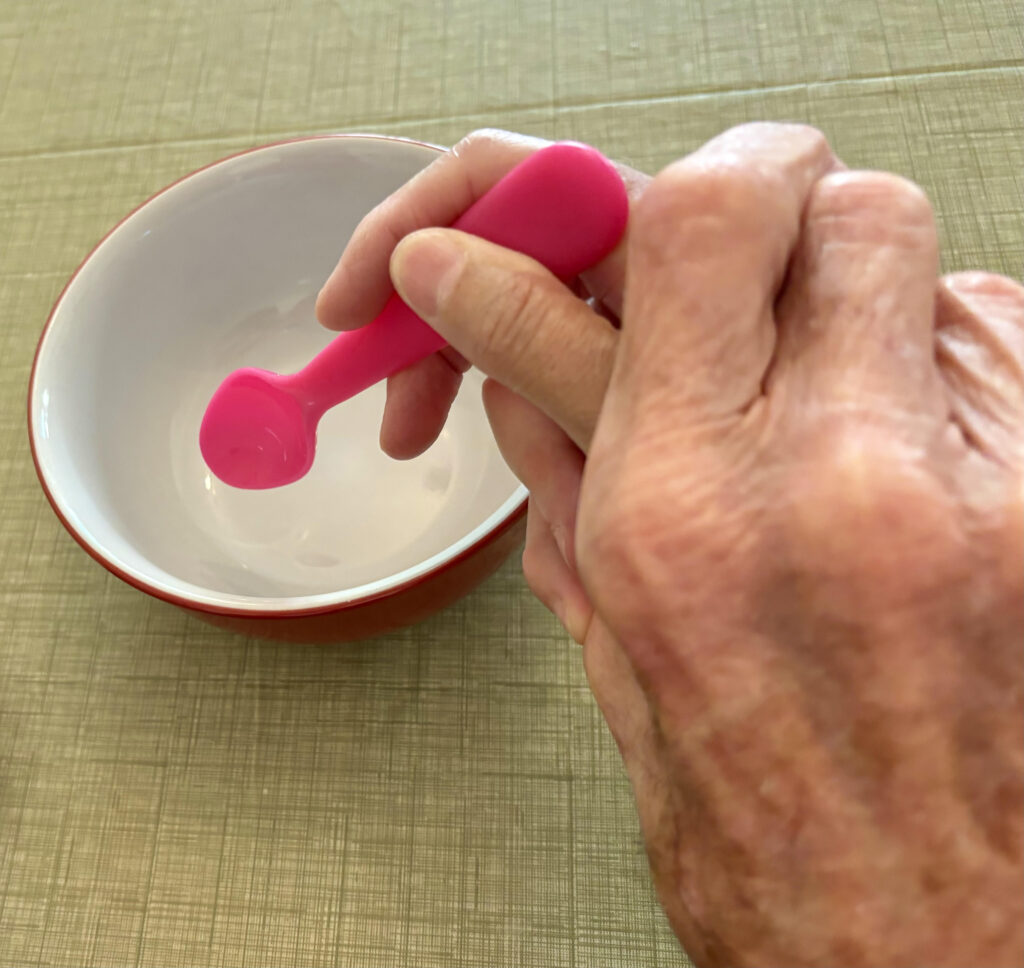
Hand under hand assist: the caregiver holds the spoon and the resident’s hand is placed over the caregiver’s hand. Use the dominant hand of the resident (left/right) and sit next to the resident on their left or right dominant side. This technique allows ease in assisting while giving the resident some control of their meal intake.