We Are Mighty!

Understanding Powerlessness As we navigate through our daily care routines we sometimes experience residents reacting in unexpected ways that can be confusing. That confusion calls for curiosity on our part. We can ask ourselves, and them, what could be the underlying reason for declining care — “No, I don’t need a shower!” The Emotional Impact of Needing Care A loved one who needs assistance for daily activities may feel helpless, anxious, and/or depressed. These feelings of powerlessness can be profound and create barriers to many aspects of care. This can include medication assistance, bathing and grooming, and participation in social activities. How can we help reduce these feelings of powerlessness and create a sense of strength and belonging? Building Confidence Through Tools and Preparation Our approach means so much! And developing a variety of tools in our caregiver tool kit can give us the confidence we need to create a…

Continue ReadingWe Are Mighty!

Caregiving and Alzheimer’s: You Get What You Give

A favorite song from my law school days came on Sirius XM radio yesterday and brought back fond memories: You Get What You Give by The New Radicals (1998). The sentiment “you get what you give” was certainly true for me during my night school experience at Golden Gate University School of Law—put in the focus and effort needed (even when I didn’t feel like it), and you will pass your exams. Don’t, and you’ll quickly learn you won’t be returning next semester. Setting the Tone in Caregiving The song has an upbeat rhythm and fun melody, yet it shares a deep insight into the consequences of our choices, especially during difficult times. As caregivers for people living with Alzheimer’s, we can set an upbeat tone—or not. We have that choice. They do not. Setting an upbeat done in a licensed care home, or any home, requires intention. The foundation…

Continue ReadingCaregiving and Alzheimer’s: You Get What You Give

Caregiver Burnout: A Self-Care Guide

Intentional and Nurturing Self Care: We Need to Create Our Own Entourage! “It’s like a sandwich with two pieces of bread and the good stuff is on the inside. But I can’t get through the pieces of bread.” — A resident’s description of what it feels like when having problems remembering words. Caring for people living with brain change is an honor — full of life lessons and heart work. If I had followed my earlier ideas of practicing law, I would be a very different person. Not sure how, but I am confident this path has shaped me more than any other. I continue to be awe-struck by its many challenges, including the risk of caregiver burnout. Give me a magic wand, though, and I would create a concierge service for caregivers composed of the best in their field, including a dietician, home chef, personal trainer, and spiritual life…

Continue ReadingCaregiver Burnout: A Self-Care Guide

Unconditional Love

Therapy pets without a doubt can improve mood and facilitate social interaction for people living with dementia. Pets can also have a calming effect, help with dementia-related behavioral problems, increase physical activity, and add a loving dimension to a care community.  Interestingly, and sort of oddly, when I searched for online resources about therapy pets and Alzheimer’s I found many articles about robotic animals for people living with dementia. Having raised and trained three amazing therapy cats over the past 14 years I clearly feel a bias towards real animals for pets. They, however, require much care and effort, and that could be a major barrier to many who are already struggling with caring for their loved one as it is. And so we have choices for our loved ones— some with intricate mechanical movements and some who will need a real litter box. When I began working with elders…

Continue ReadingUnconditional Love

Silver Bells

Bing Crosby singing Silver Bells with Rosemary Clooney puts me straight into the holiday spirit. Their voices blend and harmonize; weaving a cozy feeling with vivid scenes of a bustling city frozen in time.  As a student in the Music Department at CSU Chico I practiced vocal harmonies on a nearly daily basis.  Sometimes with a large group of choral singers, but often alone in a small practice room where I could dedicate myself to practicing without fear of making a mistake in front of others. Vocalists can feel vulnerable or anxious about outside criticism because our instrument is our own unique sound. But criticism is essential for improving; getting feedback from peers or a mentor can make all the difference between a mediocre performance and one that can truly move an audience.  I had wonderful mentors who developed and owned tremendous talent, and with their support I got more than…

Continue ReadingSilver Bells

Groundhog Day

I adore the Bill Murray movie Groundhog Day because the story manages to philosophically explore how we approach learning from the mistakes we make in life and yet find a way to laugh at ourselves and set aside our egos. We laugh along with Bill’s struggle to overcome the repetitive loop he is stuck living every day — That is until he breaks free from his usual cynical, rigid way of seeing himself and the world.  Working with people living with dementia and memory loss can feel like “Groundhog Day” and challenges us to turn around our internal process so that our response to the repetitiveness is one of understanding and compassion.  I will give you a recent example when I started my 8:30 am routine with a long list of important agenda items for my day as I walked into work. I said hello but avoided engaging with a…

Continue ReadingGroundhog Day

Aging is Not a Linear Progression 

As our society now shifts toward a prominently aging baby boomer demographic, more studies are underway to better understand how we age, and the choices we make for aging well.  Approaching 45? Time to review alcohol consumption and low carb meal options. Nearing 60 (like me) and it’s time to start pumping iron and build up muscle. Each person being unique, it’s really about self knowledge at every age, and self knowledge is a good thing.  Those of us working in dementia care, would add steps to take for brain health.  Knowing that brain health is connected to heart health, our purpose in life, and our social connections, we can make conscious choices to support ourselves and loved ones at any age. This morning it was all about being outdoors, under a canopy of redwood trees with three residents whose average age is 90. It was spontaneous, beautiful, and supportive of…

Continue ReadingAging is Not a Linear Progression 

The Two Arrows

Like many others in our field of dementia care, I have found that mindfulness practices like meditation gives me the resilience that is so essential to sustain my work. I was inspired for this month’s blog after a meditation during a podcast I follow: Home | The On Being Project.   Buddha observed and explained many aspects of human nature and suffering 2500 years ago that remain ever relevant today. The Buddhist allegory of The Two Arrows is a lesson related to how we choose to respond to a painful event. The first arrow, or triggering experience, causes the initial pain. The second arrow “is our reaction to the first. This second arrow is optional.” Looking at the Two Arrow analogy in a bio neurological way, our limbic system automatically kicks when triggered by a painful event, like the impact of an arrow, leaving us with only three options: fight, flight, or…

Continue ReadingThe Two Arrows

What the World Needs Now is Love Sweet Love — Dionne Warwick

We revisited the Summer of Love last Friday during Healing Arts with Diane Stenlund. She played a wonderful mix of songs from 1967 and created a scrapbook of album covers with colorful artwork inspired by the times.  Wherever one falls within a cultural phenomenon like the Summer of Love, the impact can be lasting. Reflecting on earlier experiences can reunite us with our unique identities, and offer a different perspective whether we have memory impairment or not.  We sang along to the Beatles and shook our tambourines; making connections to each other and bypassing the differences of several generations.  Memory loss can be devastating at times. We all hope that the last Alzheimer’s patient will come in our lifetime. One of the important steps in tackling this sticky neurological disease is getting standardized testing for primary care physicians. It looks like we have such a test: The p-tau217 blood test combined…

Continue ReadingWhat the World Needs Now is Love Sweet Love — Dionne Warwick

Stroke on the Rise

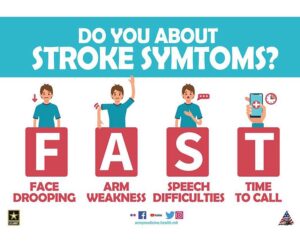
In the early 1990s I worked in skilled nursing facilities doing therapeutic activities with frail elders, and about a third of the population I assisted were recovering from a stroke. Much of my training and experience was focused on how to improve post stroke conditions that included partial paralysis, contractures, speech and communication impairments, delayed auditory processing and muscle weakness.  During that nearly 10 years of working in a nursing home setting, public health and medical communities were making solid strides toward decreasing incidence of stroke through medications for hypertension, statin medications, changes in dietary guidelines and smoking laws. The goal was to decrease levels of disability associated with aging — stroke being one of the biggest culprits.  As I started researching materials this month to prepare for a staff training on how to respond to signs of stroke, I realized that we are headed in the wrong direction. Since…

Continue ReadingStroke on the Rise